

Blog
Understanding Chronic Pain: How SoftWave Targets the Source, Not Just Symptoms
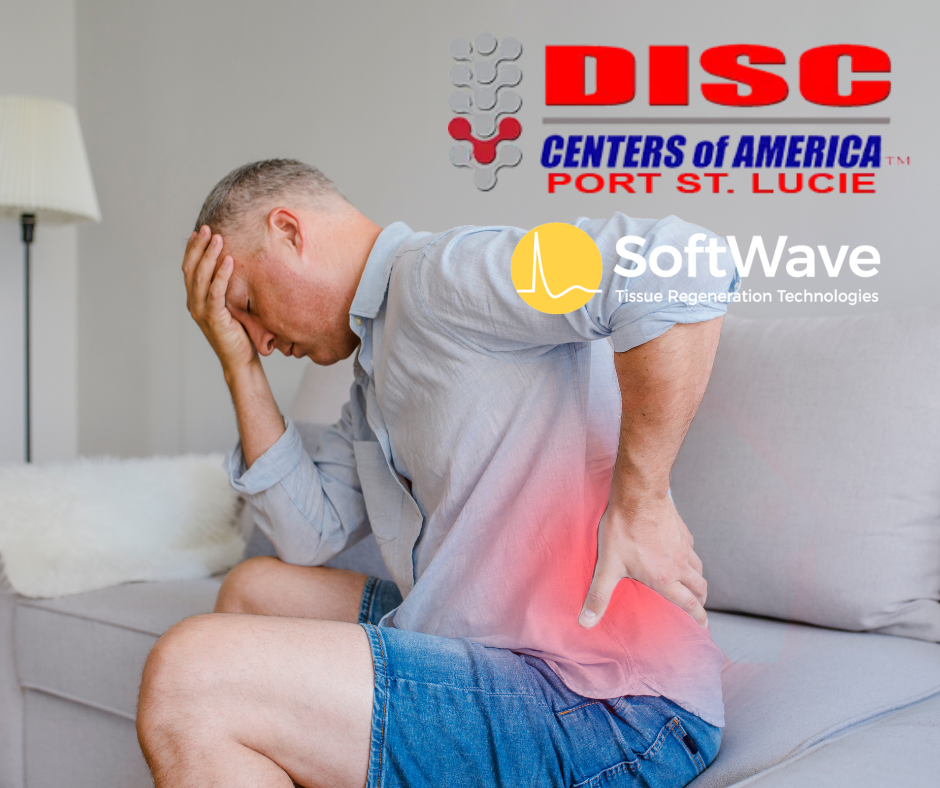
Why Does Chronic Pain Stick Around? A Port St. Lucie Guide to the Real Source
If you live in Port St. Lucie and you have been dealing with pain that just will not quit, you already know how exhausting it becomes. The ache that lingers for months, the stiffness that greets you every morning, the discomfort that flares up for no obvious reason. You have tried rest, pills, maybe a brace or a heating pad, and yet the pain keeps returning. That pattern is frustrating, but it is also a clue. Chronic pain that persists is often a sign that something in the tissue never fully healed, and covering it up is not the same as fixing it.
At Disc Center of America Port St. Lucie, Dr. John Grassam takes a different view of long-standing pain. Instead of chasing symptoms, the goal is to understand why the body got stuck and to help it restart the healing work it stalled on. One of the tools used toward that goal is SoftWave Tissue Regeneration Technology, a non-invasive approach designed to address the underlying tissue rather than simply quiet the alarm bells.
What Actually Makes Pain Become Chronic
Acute pain makes sense. You twist an ankle, the area swells, it hurts, and over a few weeks it heals and the pain fades. That is the body working exactly as designed. Chronic pain is different. By definition it outlasts the normal healing window, often defined as pain that persists beyond three months. When pain hangs around that long, the reasons usually fall into a few overlapping categories.
Tissue That Never Fully Healed
Sometimes an injury heals on the surface but leaves behind weakened, disorganized tissue underneath. Ligaments, tendons, and the soft structures around joints have relatively poor blood supply, which means they can be slow to repair. If the healing process runs out of steam before the job is done, you are left with tissue that is fragile and prone to reinjury. It may feel fine at rest, then complain the moment you ask more of it.
Ongoing, Low-Grade Inflammation
Inflammation is supposed to be a short-term visitor. It rushes in to clean up damage, then leaves once the work is done. In many chronic pain situations, that off switch never fully flips. A low simmer of inflammation continues in the background, irritating the surrounding structures and keeping the area sensitive. This is one reason chronic pain can feel like it has a mind of its own.
Nerves That Have Become Sensitized
When pain signals fire over and over for a long time, the nervous system can turn up its own volume. The nerves and the spinal cord become more reactive, so signals that would normally register as mild feel much stronger. This is called sensitization, and it helps explain why the amount of pain someone feels does not always match what an X-ray shows. The wiring itself has changed.
Masking Symptoms Versus Addressing the Source
Most conventional approaches to chronic pain focus on turning down the signal. Pain relievers, anti-inflammatory medication, and similar options can be genuinely useful, especially in the short term, and no responsible provider would dismiss them. But it is worth being honest about what they do. They change how you perceive the pain. They do not rebuild weakened tissue or finish a healing process that stalled out.
Think of it like a smoke detector chirping in your hallway. You can pull the battery and enjoy the silence, but the chirp was information. If there is smoldering tissue underneath your pain, quieting the alarm without addressing the cause means the underlying problem is free to continue. That is not an argument against comfort. It is an argument for pairing comfort with a plan that actually targets the tissue.
How SoftWave Is Designed to Restart a Stalled Healing Process
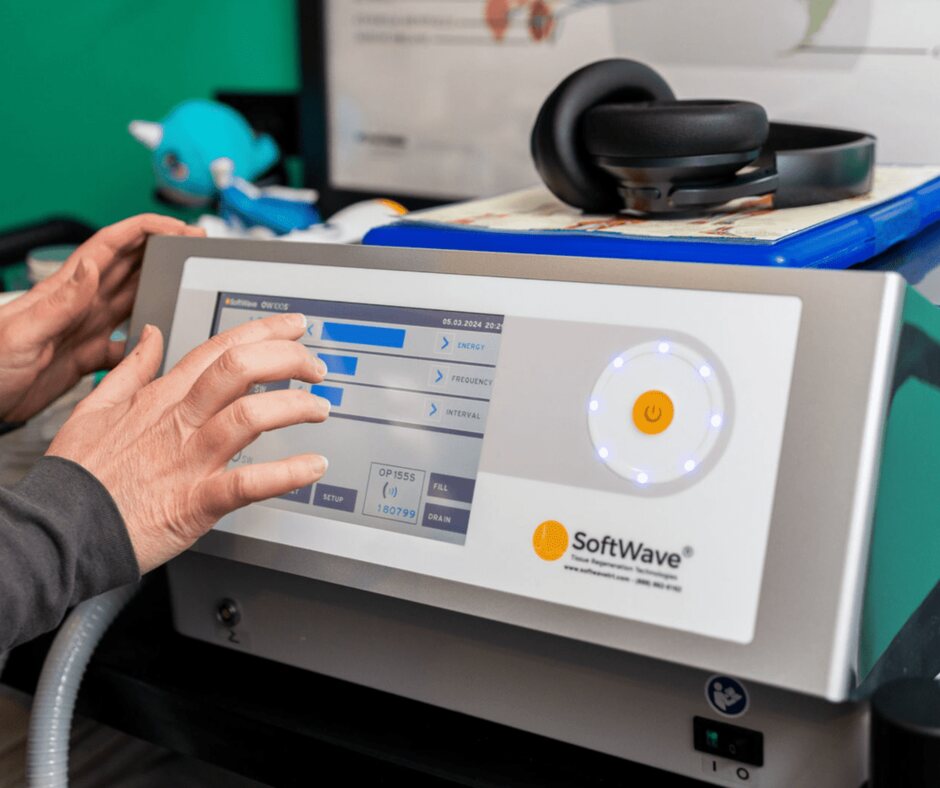
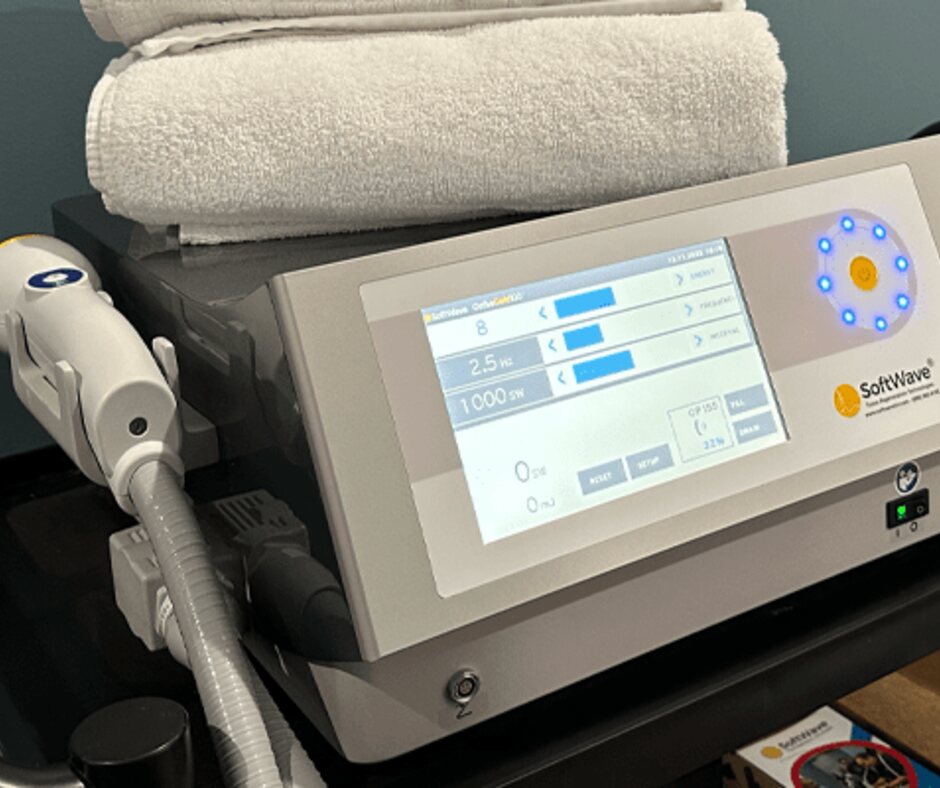
SoftWave TRT approaches chronic pain from the tissue side of the equation. It uses electrohydraulic, spark-generated acoustic waves delivered through a patented parabolic reflector. That design produces broad-focused shockwaves, which sets it apart from radial, electromagnetic, and piezoelectric devices. In plain terms, the energy is spread across a wide, deep zone rather than concentrated in a narrow point, allowing it to reach the structures involved in a healing process that got stuck.
The core idea is not to numb the area. It is to send the body a strong signal to get back to work in tissue that quit healing too early. Here is what SoftWave is designed to do, described in plain language:
- Wake up resident stem cells. The waves are designed to activate the body's own repair cells and encourage them to migrate toward the area that needs attention.
- Encourage new blood flow. Through signaling molecules such as VEGF and eNOS, the technology is designed to support angiogenesis, the formation of new blood vessels. Better circulation means better delivery of the raw materials healing requires.
- Support cell proliferation and collagen. Markers like PCNA and BMP are associated with cells multiplying and producing the collagen that gives tissue its strength.
- Modulate inflammation. Rather than just blocking inflammation, SoftWave is designed to help regulate it, including influence on toll-like receptors, so the process can move forward instead of idling.
- Clear out worn cells. The approach is designed to help clear senescent cells, the aged, non-functional cells that can clutter a repair site.
None of this is a promise of a cure, and it should not be read that way. What it represents is a mechanism aimed at the source of chronic pain rather than only its sensation. By nudging circulation, cellular activity, and inflammation back toward a healing pattern, the goal is to give stalled tissue a genuine chance to finish what it started.
If you are tired of masking pain and want to understand whether the underlying tissue can respond, the team at Disc Center of America Port St. Lucie is ready to help. Schedule your SoftWave consultation in Port St. Lucie today and take the first step toward a plan built around the source.
What to Expect at Disc Center of America Port St. Lucie
Many patients appreciate how straightforward the SoftWave experience is. It is non-invasive, with no needles, no drugs, no surgery, and no downtime afterward. Individual sessions are brief, often around ten to fifteen minutes, and care is typically delivered as a series over roughly six to eight weeks. Because the technology is designed to stimulate your own biology, many patients report that improvement can continue for weeks and even months after the final session as the body keeps working.
An Honest Approach to Care
Dr. Grassam believes in setting realistic expectations. SoftWave is not a magic wand, and it does not replace medical advice for serious or complex conditions. Instead, it is one evidence-informed tool used within a thoughtful plan. The technology has been studied at leading institutions and is used by clinicians who work with professional and collegiate athletes. During your visit, your situation is assessed on its own terms so you understand whether this approach is a reasonable fit for you.
Chronic pain does not have to be something you simply learn to live with by turning down the volume. When the real issue is tissue that never fully healed, ongoing inflammation, and sensitized nerves, it makes sense to choose a strategy aimed at those very things.
Ready to Take the Next Step?
If chronic pain has been running your life, you owe it to yourself to explore an approach built around the source rather than the symptom. Reach out to our Port St. Lucie team and find out whether SoftWave therapy is right for you.
Request your SoftWave Therapy new patient visit online today
Contact Disc Center of America Port St. Lucie
Disc Center of America Port St. Lucie
555 NW Lake Whitney Place, Ste. 105
Port St. Lucie, FL 34986
Phone: (772) 237-2080
Our Main Office Website: https://portstluciedisccenter.com/
‹ Back
Recent Posts
-

-
-
-

How SoftWave Therapy and Chiropractic Care Work Together
June 11, 2026
-

 555 NW Lake Whitney Place Ste. 105